
Leadership is often explained through frameworks, models, and best practices. Yet every so often, we encounter individuals whose actions simply don’t fit the textbook. They respond differently, think differently, and feel differently — and in doing so, they change the trajectory of people, organisations, and even nations. In this post, we explore examples of Beyonders: individuals and moments where leadership transcends logic, convention, and expectation.
What Is a Beyonder?
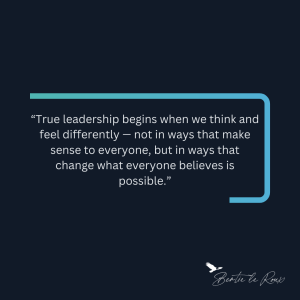 A Beyonder is not easily defined, and that is precisely the point. What one person recognises as extraordinary leadership may look irrational or even reckless to another. Beyonders are individuals who operate from a deeper internal compass. They are often driven less by what is considered a “reasonable” decision and more by values, intuition, and emotional conviction.
Rather than following established rules, Beyonders challenge them. Rather than reacting predictably, they respond authentically. This form of leadership is not about being right in the moment — it is about being impactful over time.
Thinking and Feeling Differently
One of the defining traits of a Beyonder is the ability to think differently — but equally important is the ability to feel differently. Beyonders don’t simply apply logic to a situation; they engage emotionally with what is at stake. Their decisions are informed by empathy, purpose, and long-term vision, even when those decisions defy conventional wisdom.
This is often why Beyonders are misunderstood in their time. Their actions don’t always align with existing theories or leadership norms. In fact, if their thinking were easy to explain or replicate, it would likely already be mainstream.
Nelson Mandela: Beyondership from the Inside Out
Nelson Mandela stands as one of the clearest examples of beyondership. After spending many years in prison, the expectation was that he would emerge embittered, vengeful, or at the very least cautious. Instead, he changed the mindset of a nation through how he acted and what he said.
Mandela approached life and leadership in a way that no one anticipated. His ability to forgive, reconcile, and lead inclusively redefined what leadership looked like in a deeply divided context. In hindsight, his impact seems obvious. At the time, however, it was beyond comprehension. He was, quite simply, a Beyonder from the inside out.
Beyonder Moments vs Beyonder Individuals
Not everyone who exhibits beyondership does so consistently. An important distinction is that people can have Beyonder moments without necessarily being Beyonders as a permanent identity.
These moments often arise in high-pressure or high-stakes situations — a crisis, a trauma, a split-second decision where there is no time to consult theory or process. In such moments, people sometimes act in ways that surprise even themselves. No leadership model could have predicted the response, yet the outcome is profound.
These moments remind us that beyondership is not reserved for a select few. It is a capacity that can emerge when circumstances demand more than routine thinking.
Elon Musk: Applied Beyondership
In a more contemporary context, Elon Musk represents a form of applied beyondership. Much of what he pursues has not been attempted — or seriously considered — by others at the same scale or speed. His approach often challenges traditional development models, particularly in industries where risk aversion dominates.
What is notable is his focus on thinking capability over technical skill. Musk himself has stated that skills can be taught, but the ability to think differently — and to fit within a culture that values unconventional thinking — is far harder to develop. This reinforces the idea that beyondership is less about competence and more about cognitive and emotional adaptability.
Richard Branson: Living Beyondership Without Naming It
Richard Branson may never label himself a Beyonder, yet his life and career reflect the concept clearly. From his early days in the music industry to building global businesses, Branson has consistently approached life and business differently.
He has made bold decisions, embraced failure as part of the journey, and prioritised people and culture over rigid structures. Some decisions worked brilliantly; others did not. Yet the cumulative impact is unmistakable. Branson embodies beyondership not as a strategy, but as a way of being.
Why Beyondership Matters Today
In an increasingly complex and uncertain world, leadership that relies solely on precedent and logic is no longer sufficient. Organisations face challenges that have no clear roadmap. In this environment, Beyonders — and Beyonder moments — become essential.
They push boundaries, question assumptions, and create new possibilities. They remind us that progress is rarely comfortable and almost never predictable.
Summary
Examples of Beyonders show us that leadership is not just about making the right decision according to existing rules. It is about responding with courage, empathy, and conviction when no clear answer exists. Whether through individuals like Nelson Mandela, Elon Musk, and Richard Branson, or through fleeting moments where ordinary people rise beyond expectation, beyondership challenges us to expand how we define leadership itself.
So here’s the question:
Where in your leadership, business, or life might you be called to step beyond logic — and what would it look like if you trusted that instinct?