
In today’s fast-paced and performance-driven environments, teams are often assembled with high expectations but deliver inconsistent results. While many leaders look at skills, strategy, or systems as the root cause, there is a deeper, often overlooked factor that quietly undermines team success—ego. The presence of the “I” in a team dynamic can be the very thing that limits collaboration, erodes trust, and ultimately stalls growth. Understanding and addressing this is not just good leadership—it’s a strategic imperative.
The Hidden Barrier to Team Success
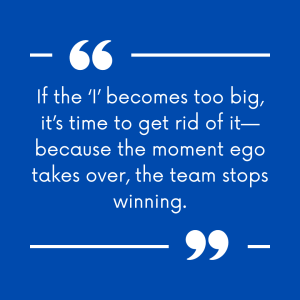 When teams struggle, it’s easy to attribute failure to external factors such as market conditions, lack of resources, or poor execution. However, when you dig deeper, a recurring theme often emerges: individual ego.
Ego shows up subtly. It appears in the need to be right, the desire to dominate conversations, or the unwillingness to consider alternative perspectives. Over time, this creates friction within the team. Instead of working toward a shared goal, individuals begin competing for recognition, control, or validation.
The moment this happens, the team dynamic shifts. Collaboration is replaced by competition, and trust begins to erode.
Understanding the Power of Collective Contribution
High-performing teams operate on a fundamentally different principle—they recognize that every individual brings unique strengths to the table. No single person has all the answers, and no one role is more important than another when it comes to achieving collective success.
When team members are empowered to contribute their strengths, something powerful happens. The team becomes more adaptive, more innovative, and more resilient. This is often referred to as “whole-brain thinking”—leveraging diverse perspectives to solve problems more effectively.
But this only works when individuals are willing to set aside their ego and trust the process.
When the “I” Becomes Too Big
There is a tipping point in every team. When the “I” becomes too dominant, it begins to overshadow the “we.” At this stage, decision-making becomes centralized, collaboration declines, and other team members may disengage.
Ego doesn’t just impact relationships—it impacts results.
Leaders must be vigilant in recognizing when this shift occurs. It may show up as reduced participation in meetings, increased conflict, or a lack of alignment around goals. These are signals that the team is no longer functioning as a cohesive unit.
Addressing this requires intentional effort. It means creating a culture where humility, respect, and shared ownership are not just encouraged but expected.
Redefining Leadership: From Control to Collaboration
Effective leadership is not about control—it’s about creating an environment where the team can thrive. This requires a shift from “I lead” to “we succeed.”
Leaders play a critical role in setting the tone. By modeling collaborative behavior, actively listening, and valuing input from all team members, they create a culture where ego has less space to grow.
Consensus-driven decision-making is a powerful tool in this regard. When teams are involved in the decision-making process, they are more invested in the outcomes. This not only improves execution but also strengthens trust and accountability.
Building a Culture of “We”
Creating a high-performing team is not a one-time event—it’s an ongoing process. It requires consistent reinforcement of the principles that drive collaboration and shared success.
Here are a few key practices to embed a “we” culture:
Encourage open communication and diverse perspectives
Recognize and celebrate team achievements, not just individual wins
Establish clear roles and responsibilities while promoting interdependence
Address ego-driven behaviors early and constructively
When these practices are consistently applied, the team begins to operate as a unified entity rather than a collection of individuals.
The Cost of Ignoring the Ego Factor
Ignoring the impact of ego can have significant consequences. Teams may experience high turnover, reduced morale, and missed opportunities. More importantly, they may never reach their full potential.
On the other hand, teams that successfully minimize ego and prioritize collective success often outperform expectations. They are more agile, more innovative, and better equipped to navigate challenges.
In a competitive business landscape, this can be a decisive advantage.
Summary
At its core, team success is not just about what individuals bring—it’s about how they come together. The presence of ego can quietly derail even the most talented teams, while a focus on collective contribution can unlock extraordinary results.
The shift from “I” to “we” is not always easy, but it is essential. It requires self-awareness, intentional leadership, and a commitment to building a culture of trust and collaboration.
When teams embrace this mindset, they don’t just perform better—they thrive.
So here’s something to reflect on:
Where might the “I” be showing up in your team—and what steps can you take today to strengthen the “we”?