
There are moments in life and leadership when something just feels… different. What once energized you now drains you. What once felt aligned now feels forced. Instead of ignoring that tension, what if we saw it for what it truly is — a signal? Often, the earliest sign that change is coming is not external chaos, but internal discomfort. And if we are willing to pay attention, that discomfort can become the catalyst for powerful transformation.
Discomfort Is the First Indicator
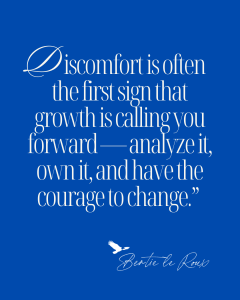 By its very nature, growth disrupts comfort. When you begin to feel unsettled in your work, relationships, or environment, it’s tempting to label it as stress, frustration, or dissatisfaction. But beneath those emotions lies a deeper question: What has changed?
Sometimes you have changed. Your values have evolved. Your capacity has expanded. Your vision has grown. Other times, the environment around you has shifted. Expectations rise. Culture erodes. Dynamics transform.
The key is awareness.
Instead of reacting impulsively, pause and analyze the discomfort. Ask yourself:
Am I still challenged here?
Am I adding and receiving value?
Is this environment aligned with who I am becoming?
Discomfort is not always negative. It is often an invitation.
Growth Demands Movement
Transformation implies action. Growth requires movement. Nothing in nature grows without change. A seed planted in the ground must break open before it can become a plant. The process is disruptive — yet necessary.
The same principle applies to us.
Whether it’s transitioning roles, shifting industries, redefining relationships, or adjusting leadership style, growth always stretches us beyond our previous identity. The courage lies not in avoiding change, but in embracing it.
Change may be challenging. It may feel uncertain. It may even feel risky. But stagnation carries a far greater cost.
You Can’t Change Others — Only Yourself
One of the most powerful realizations in times of discomfort is this: you cannot change other people.
If you feel unfulfilled at work, it may be easy to blame leadership, salary, or workload. If you feel disconnected in a relationship, you may focus on the other person’s shortcomings. But meaningful change begins with self-examination.
Are you bored because you are no longer challenged?
Are you drained because your contribution is not recognized?
Are you misaligned because your values have shifted?
You can pivot your mindset instantly. You can adjust your behavior. You can choose new standards. But attempting to control others only creates further frustration.
Ownership is empowering.
Fulfillment Over Production
In today’s performance-driven world, organizations often prioritize efficiency, output, and cost-cutting above all else. But somewhere along the way, many have forgotten a fundamental truth: business is about people.
When individuals feel unappreciated, undervalued, or unseen, productivity inevitably declines. People do not wake up inspired to contribute where they feel invisible.
Money, while important, is rarely a lasting motivator. It may spark short-term effort, but it does not sustain long-term engagement. Fulfillment, growth, and appreciation do.
Leaders who understand this invest in culture. They create environments where people feel energized, not depleted. They design structures that recognize individuality, well-being, and purpose.
And the results speak for themselves.
Culture Is Created Intentionally
Attitudes form culture. Culture determines performance.
When people arrive at work disengaged, emotionally withdrawn, or simply present in body but not in spirit, the culture suffers. Toxic dynamics — bullying, exclusion, disrespect — quietly erode organizational health.
High-performing environments do not happen by accident. They are designed intentionally.
Forward-thinking leaders prioritize mental health, flexibility, and trust. Some implement structured personal time at the start of the day, allowing employees to ground themselves before diving into tasks. Others actively encourage physical well-being, understanding that energy drives performance.
When individuals are supported holistically, their output in fewer focused hours can exceed what others achieve in double the time.
Alignment fuels efficiency.
Not Everyone Will Fit — And That’s Okay
Another sign that change is coming is cultural misalignment.
Sometimes, despite best efforts, an individual simply does not fit within a particular environment. Forcing alignment where it does not exist creates tension for everyone involved.
Healthy leadership recognizes this without resentment. Instead of coercion, there is clarity. Instead of conflict, there is conversation.
Helping someone transition to an environment better suited to their strengths is not failure — it is wisdom.
Not every season is meant to last forever.
Courage Is the Turning Point
Recognizing discomfort is one thing. Acting on it is another.
It takes courage to admit that you have outgrown a role. It takes courage to leave a familiar environment. It takes courage to shift identity, pursue entrepreneurship, or reimagine your path.
But courage is the bridge between stagnation and growth.
Whether you change today or tomorrow, change is inevitable. The real question is whether you will move intentionally or wait until circumstances force the shift upon you.
Discomfort is not the enemy. It is feedback.
Final Thoughts
When something no longer fits, pause before you panic. Reflect before you react. Analyze before you accuse. Discomfort may be signaling growth, realignment, or transformation.
Change is part of progress. Growth requires movement. And fulfillment begins with self-awareness.
What area of your life or leadership currently feels uncomfortable — and could that discomfort be pointing you toward your next level?