What if the very rules you were taught to follow are the same ones limiting your growth today? From a young age, many of us were conditioned to operate within clearly defined boundaries—stay inside the lines, follow instructions, don’t break what’s given to you. But what if those “rules” were never designed to unlock creativity, but rather to control it? The concept of “broken crayons” challenges us to rethink how we see limitations, tools, and ultimately, ourselves.
The Conditioning That Shapes Us
 As children, we are taught structure. There is a “right way” to do things, and anything outside of that is often corrected. Think about something as simple as a crayon. You’re told to color neatly, stay within the lines, and use the crayon as intended. If it breaks, it’s seen as a problem. If you peel off the paper, you might even get into trouble.
These small moments of correction may seem insignificant, but over time they compound into a mindset. A mindset that says: don’t deviate, don’t experiment, and don’t challenge the norm. As we grow older, this conditioning doesn’t disappear—it evolves. It shows up in our businesses, our leadership styles, and our willingness (or unwillingness) to innovate.
The Crayon Is Still Useful
Here’s the powerful shift: a broken crayon still colors.
Just because something doesn’t look the way it used to, or function in the traditional sense, doesn’t mean it has lost its value. In fact, it may have unlocked new possibilities. A broken crayon can be used differently—held at a different angle, applied with broader strokes, even combined with other colors to create something entirely new.
The same applies to people, ideas, and businesses. What we often label as “broken” may simply be an opportunity for reinvention. When we move beyond rigid definitions, we open ourselves up to creativity and growth.
Left Brain vs Right Brain Thinking
There’s an interesting contrast between structured thinking and creative thinking. The “left brain” perspective tends to focus on logic, rules, and functionality. From this viewpoint, a crayon has a specific purpose: to color neatly within the lines.
But the “right brain” sees possibility. It asks, “What else can this do?” It explores using the side of the crayon, mixing colors, or even breaking it intentionally to achieve a different effect.
In a business context, both ways of thinking have value. Structure provides consistency and efficiency. But without creativity, there is no innovation. The challenge—and opportunity—is to balance both, without allowing structure to suppress imagination.
Breaking the Rules to Create Something New
At some point, growth requires us to challenge the very rules we’ve been following.
This doesn’t mean abandoning discipline or disregarding best practices. It means questioning whether the current way is the only way. It means being willing to “break the crayon” in order to discover new methods, new strategies, and new outcomes.
Many of the most successful ideas didn’t come from people who followed the rules perfectly—they came from those who saw beyond them. They asked better questions. They experimented. They stepped outside the lines, even when it felt uncomfortable.
The Box We Live In
One of the most limiting beliefs we carry is the idea that crossing the line is unacceptable. This belief often goes unchallenged, shaping our decisions without us even realizing it.
We stay in roles that no longer serve us. We stick to strategies that no longer work. We hold onto definitions of success that were given to us, rather than creating our own.
The “box” isn’t always visible—but it’s there. And the moment you recognize it, you have a choice: stay within it, or step outside and redefine what’s possible.
Creativity as a Competitive Advantage
In today’s fast-paced, ever-evolving world, creativity is no longer optional—it’s a differentiator. The ability to think differently, adapt quickly, and see opportunity where others see limitation is what sets individuals and businesses apart.
When you embrace the “broken crayon” mindset, you begin to see resources differently. You stop focusing on what’s missing and start leveraging what’s available. You move from a place of restriction to a place of expansion.
And that shift changes everything.
Summary
The lesson of broken crayons is simple, yet profound: limitations are often just perceptions. What we’ve been taught to see as flaws or constraints may actually be gateways to creativity and growth. By challenging the rules, embracing new perspectives, and allowing ourselves to think beyond traditional boundaries, we unlock potential—not only in our tools and ideas, but in ourselves.
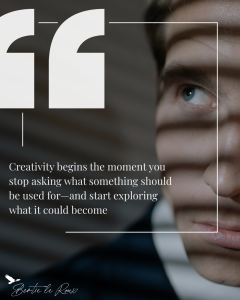
So instead of asking, “What is this supposed to do?” start asking, “What else could this become?”
What rules or “lines” have you been following that might be limiting your growth—and what would happen if you chose to step beyond them? 🚀